
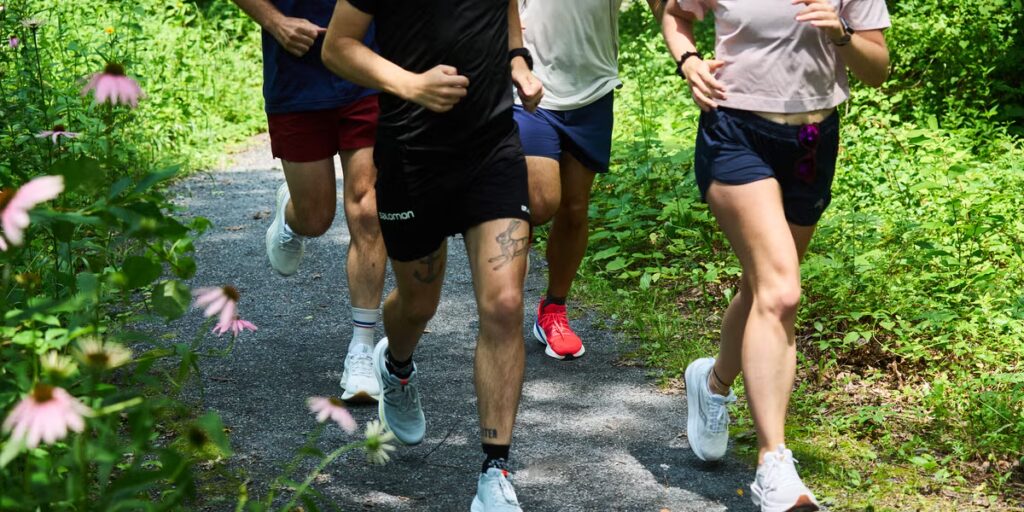
Running is commonly acknowledged for its role in enhancing endurance, but it also significantly contributes to muscle strength. Distances that may initially appear daunting, such as one or five miles, become achievable with consistent practice. The effort required for sprinting toward the finish line or navigating inclines underscores the physical challenges encountered by runners.
This raises an important question: does running actually foster muscle growth? Can simply increasing your running distances affect your body composition?
The answer is yes, although multiple factors influence this result. Below is a thorough exploration of how running impacts muscle mass.
The Mechanisms Behind Running’s Muscle-Building Effects
Research indicates that running can indeed stimulate muscle growth. A review from 2015 published inExercise and Sport Sciences Reviewssuggested that aerobic exercise could enhance both skeletal muscle and overall muscle size, particularly in individuals who have been inactive in the past. This implies that those embarking on their running journey are likely to reap muscle-building benefits. The authors of the review recommend aerobic activity as a means to combat age-related muscle loss.
Further, a study conducted in 2017 and published in theInternational Journal of Exercise Sciencediscovered that running stimulated muscle growth in the vastus lateralis, a key muscle in the quadriceps, among twelve university students who participated in recreational running. These participants engaged in roughly 25 high-intensity running sessions over a ten-week period, which involved four sets of four-minute sprints at 90 to 95 percent of their maximum heart rate, interspersed with three minutes of active recovery.
The increase in muscle mass can be attributed to the manner in which running challenges the body, particularly in the lower limbs. Joe McConkey, an exercise physiologist from Boston and a certified running coach, elaborates on this connection.
“With running, the majority of the muscle work or contraction is eccentric, which is the hardest load on the body,”
Eccentric contractions occur when muscles lengthen while under tension, akin to the lowering phase in a squat, where the quadriceps engage eccentrically.
In running, “the act of landing, where you’re absorbing two to four times your body weight, is done eccentrically. That’s the major stimulus for muscle growth during running, particularly for beginners,” McConkey explains.
The Limitations of Running in Muscle Development
Recent studies suggest that while aerobic exercise is generally effective in preserving muscle mass, it may not be as advantageous for muscle building, particularly if an individual maintains a steady routine without increasing intensity.
However, novice runners often experience notable gains in muscle mass and strength simply by increasing their running frequency or duration, especially if they are returning to the sport after a hiatus.
On the other hand, those who regularly engage in steady-state runs may not observe significant increases in muscle mass; however, they can attain better muscle definition as their body composition evolves with heightened mileage, as noted by McConkey.
If you have been running for a prolonged period, it is probable that you have fortified your slow-twitch muscle fibers, which primarily support endurance running, according to Janet Hamilton, C.S.C.S., owner of Running Strong.
All runners possess the potential to boost their strength and possibly augment muscle mass by activating their fast-twitch muscle fibers. Though these fibers are less enduring than slow-twitch fibers, they can generate greater force. Hamilton states, “These don’t really get called upon until either a) there’s an activity that requires more strength than slow-twitch fibers can muster or b) the slow-twitch fibers are fatigued and you keep going,”
To engage more fast-twitch fibers, it is essential to participate in activities that demand higher power output, like those performed by sprinters.
“Any high-powered, short bout of exercise—so long as it is progressive in nature (i.e. harder, faster, higher than what you have already adapted to)—will increase the size of fast-twitch fibers, and thus increase muscle mass,”
asserts McConkey.
In conclusion, to achieve muscle growth, individuals must significantly challenge their muscles and diversify their activities; otherwise, running may primarily maintain existing muscle rather than promote further development.
How to Maximize Muscle-Building Benefits from Running
To enhance muscle-building efforts, it is advisable to adhere to general weekly exercise guidelines: at least three cardio sessions, two strength workouts, and a minimum of one flexibility session. Incorporating these elements into your routine not only encourages muscle growth but also contributes to developing a more balanced athletic profile.
A crucial aspect of this muscle-building strategy is weight training. Strength workouts create micro-tears in muscle fibers, which heal during recovery, resulting in stronger muscles. Sufficient protein intake is also essential for this process.
When concentrating on running, a productive way to enhance fast-twitch fibers and muscle mass is through hill workouts. Hamilton observes, “Running up a hill requires more muscle power than running on level ground,” While you are not lifting weights, you effectively carry your body weight up an incline against gravity, which functions as a unique form of resistance training.
Speed workouts also activate fast-twitch muscle fibers. “If you’ve been doing nothing but easy effort, marathon-pace runs, incorporating short to moderate intervals at a faster, 5K pace is going to require you to exert more force every time your foot hits the ground,” Hamilton explains. “And that’s how you speed up—you generate a greater push-off.”
To foster muscle development through running, consider integrating the following workouts, which can be adjusted to your fitness level:
Beginner Hill Workout
- Warm up for at least 1 mile at an easy pace (or one-third of the total planned distance).
- Locate a gradual hill that takes approximately 30 to 60 seconds to climb at an easy effort.
- Ascend the hill at the same effort you would on flat ground (expect to slow down slightly).
- Descend the hill at the same effort as you would on level terrain (expect to speed up a bit).
- Repeat steps 1-4 four times (or adjust according to fitness level). For optimal results, focus on maintaining cadence rather than pace.
- Cool down for at least 1 mile at an easy pace.
Intermediate Speed Workout
- Warm up for at least 1 mile at an easy pace.
- Run 400 meters at 5K pace (a challenging effort but not a full sprint).
- Run 200 meters at a recovery pace.
- Repeat steps 2 to 4 between 2 to 4 times if you run less than 20 miles per week. For those running 20+ miles, repeat 6 times, or 8 times for those running 30+ miles per week. The goal is to maintain a hard pace; if necessary, shorten the distance to sustain that pace.
- Cool down for at least 1 mile at an easy pace.
John Vasudevan, M.D. is an associate professor at the University of Pennsylvania, board-certified in Physical Medicine & Rehabilitation and Sports Medicine. He serves as a Team Physician for UPenn Athletics and is the medical director of the Broad Street Run and Philadelphia Distance Run, having previously directed the Rock ‘n’ Roll Half-Marathon and Tri-Rock Triathlon in Philadelphia. Dr. Vasudevan leads the running and endurance Sports Medicine Program at Penn Medicine, providing non-operative management of musculoskeletal conditions for athletes and active individuals at all levels. He integrates injury rehabilitation with prevention strategies, employing various ultrasound-guided procedures and regenerative techniques such as platelet-rich plasma and percutaneous ultrasonic tenotomy. Patients can find him at Penn Medicine and the Philadelphia Veterans Administration hospital. Dr. Vasudevan completed his medical education at the University of Wisconsin School of Medicine and Public Health in Madison. Following a Transitional Year in Tucson, Arizona, he pursued residency in PM&R at Thomas Jefferson University in Philadelphia and completed a fellowship in Sports Medicine at Stanford University. He has been practicing at the University of Pennsylvania since 2012.