
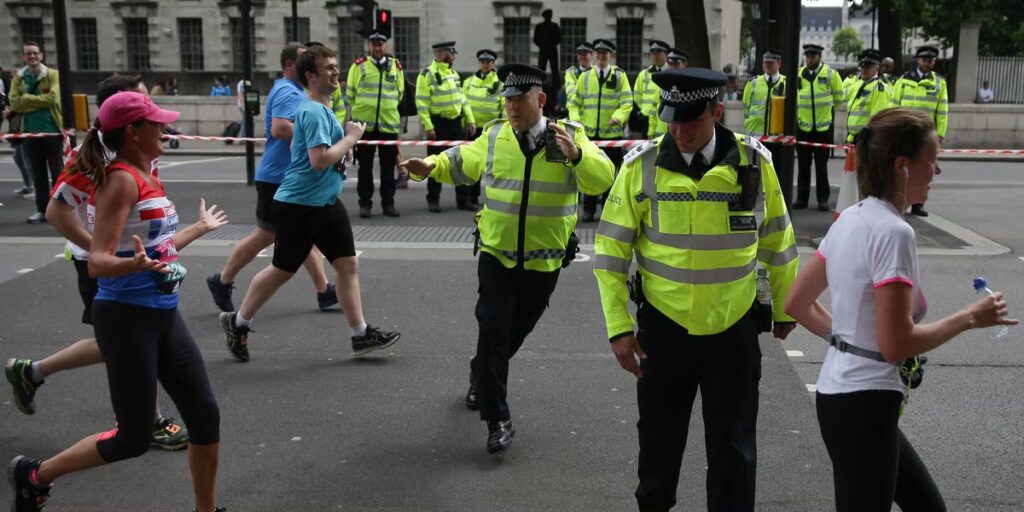
To join the British Police Force, candidates must complete a bleep test, which consists of several stages that they must successfully navigate to progress through the selection process. Reaching stage 5 necessitates passing a fitness assessment.
Officers in the police force are expected to maintain a certain level of physical fitness and stamina, enabling them to respond quickly when necessary. As highlighted in an informational video, “If you’re not at a certain level of fitness, how can you be expected to safeguard the public?”
Fitness test
Prospective police officers are required to complete a multi-stage shuttle run, commonly referred to as the bleep test. According to the official entry guidelines, “as long as you are reasonably fit and have prepared in advance, you should pass it no problem” The test is designed to gauge stamina suitable for police work rather than for Olympic-level athletes.
The bleep test involves running between two points that are spaced 15 meters apart, known as a shuttle. At pre-recorded intervals, beeps signal the need to reach the opposing side before the next sound. The timing between beeps shortens as the test proceeds.
This test lasts 3 minutes and 35 seconds and consists of 35 shuttles, with the pace increasing throughout. It begins at a speed of 7.9 kph and culminates at a maximum speed of 9.9 kph. Rated at Level 5.4 on the bleep test scale, it demands a high VO2 max to keep pace with the increasing speed of the beeps towards the end, which can be improved through interval training.
Passing this test is not only a requirement for entry into the police force; current officers must also successfully complete it on an annual basis.
Training for the bleep test
A solid foundation of running experience will benefit those preparing for the police force’s bleep test, as cardiovascular fitness is crucial for success. This can be developed through various training methods.
Steady running
Regular steady runs, performed once or twice a week, can help build endurance. A typical session might involve a 10-15 minute warm-up, followed by a 15-20 minute run at a consistent pace, and concluding with a 5-10 minute cooldown. A steady pace is characterized as a 4 or 5 on a scale of 10 for perceived exertion, allowing for short sentences but not lengthy conversations.
Easy running
In addition to steady runs, incorporating slower, easy running will help establish an aerobic base. The perceived exertion for easy running should be rated between 1 and 3 out of 10, where conversational ability is maintained throughout the run.
Intervals
To enhance the speed necessary for the bleep test, regular interval training is essential. This involves running vigorously for a brief period, followed by a recovery period, and then repeating. An effective session could include a 10-minute warm-up followed by intervals of 30 seconds of fast running followed by 30 seconds of jogging, repeated ten times.
Incorporating turns
The bleep test demands frequent changes in direction every 15 meters, which can increase the risk of injury without practice in sharp turns and pivots at speed. To mitigate this risk, incorporate training runs that involve running back and forth over a set distance, making sharp 180-degree turns at designated points.
Bleep test levels, shuttles and how long they should take
How do you think you would fare in this test? Are you suited for police work? Different roles have varying requirements; for instance, the marine police unit and the chemical, biological, radiological and nuclear response team require a standard of level 5, shuttle 4. Dog handlers and the mounted branch need level 5:7, police cyclists 5:8, while armed response vehicle personnel need to reach level 9:4 and dynamic intervention AFOs should aim for level 10:5.

Sidelined by injury? We’ve got something to help get you back on the road: our brand-new digital guide to beating any injury.
Curated by our editors, our complete guide is designed to help you spot, treat and prevent common runner’s ailments – from plantar fasciitis to knee arthritis – so you can run long, strong and pain-free.
This kind of exclusive supplement is usually only available to Club members – tap the link below to unlock 14 days of free access to the digital guide today.